

Choosing a China Best Foldable Pet Cot Manufacturer and Supplier starts with more than comparing prices. A well-made Foldable Pet Cot should feel steady on tile, grass, and other common surfaces. Look closely at its frame joints, mesh tension, stitched edges, and feet. These details affect everyday comfort and product life. Small parts matter.
For importers and retailers, clear specifications make supplier discussions more useful. Ask for cot dimensions, folded size, materials, recommended weight capacity, care instructions, and available packaging options. Request product photos or samples when practical. A supplier should explain how the frame opens and locks, and how the fabric attaches. Claims about load capacity should be supported by documented testing, not vague assurances. Check sample consistency before confirming a larger order.
There are trade-offs. A lighter frame may be easier to carry, while a sturdier design can take up more space. Mesh can improve airflow, but its weave and stitching still need inspection. Some details are easy to miss—and I would not ignore them. Compare samples under realistic conditions, including setup and folding. Ask how defects are handled and whether specifications can be confirmed in writing. A dependable manufacturer communicates clearly, shares verifiable product information, and answers practical questions without pressure. That gives buyers a sounder basis for selecting a cot that suits their customers and pets.
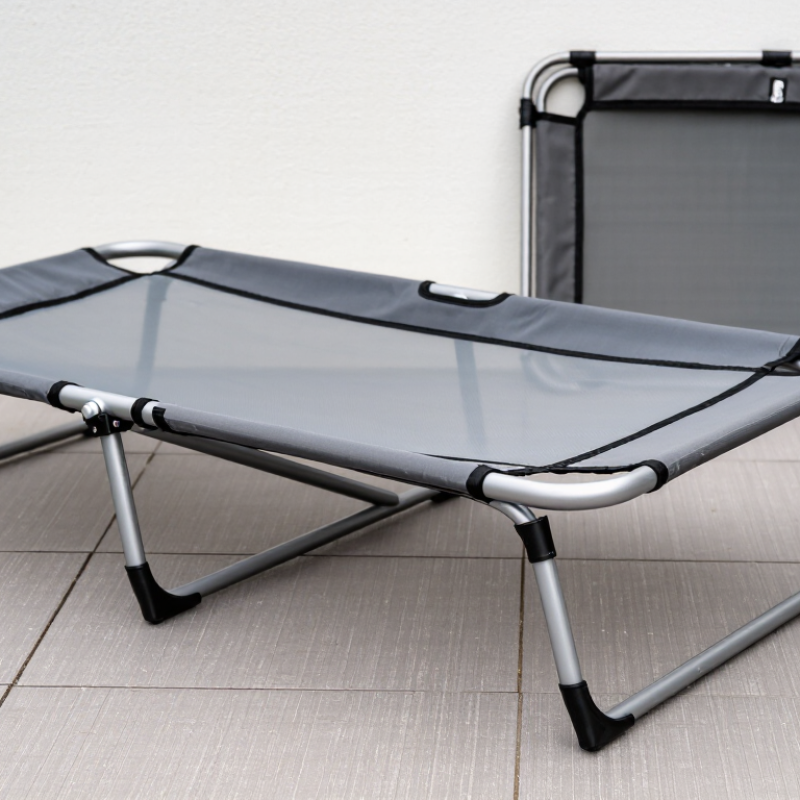
A foldable pet cot combines a collapsible frame with a fabric sleeping surface. Most frames use steel or aluminum tubes joined by hinges, while the cover may use woven polyester or mesh. Hinges should open smoothly and lock firmly; a loose joint can make the cot wobble under a shifting pet. Check the feet, too. They help prevent sliding on tile and protect floors from scratches. The fabric should be taut, but not drum-tight, so it can support weight without stressing the seams.
Elevated mesh cots keep pets off cold floors and allow air to pass beneath them. They suit warm rooms, patios, and dogs that prefer a firmer surface. Padded foldable cots offer more cushioning for indoor naps, though thick padding can retain heat and takes longer to dry. Compact travel models fold into smaller bundles and may include a carry bag. Some heavier-duty versions use reinforced corners and wider feet for larger pets. “Heavy-duty” still needs a weight rating.
Match the cot to the pet’s size and habits. Measure from nose to tail while the pet is lying down, then allow room to stretch. A nervous chewer may damage exposed fabric or straps, so inspect those areas regularly. No type fits every home. Even a sturdy cot can feel unstable on uneven ground, and foldable joints deserve occasional checks. Small details matter. A washable cover is useful, but confirm that it can be removed without forcing the frame apart.

China Best Foldable Pet Cot Manufacturer and Supplier
The American Pet Products Association reported that U.S. pet industry spending reached $152 billion in 2024. Its 2025 State of the Industry figures show how substantial the market has become. That number covers many categories, not just beds, so it should not be treated as a direct forecast for foldable pet cots. Still, it signals strong consumer investment in pet care. Buyers often look for practical products that fit real routines: a raised resting surface, quick folding, and storage beside a car or in a closet.
For manufacturers and suppliers, usefulness depends on details. Check frame stability, hinge movement, fabric tension, and how easily the cot can be cleaned. A cot that looks compact online may feel awkward when folded or heavy to carry. Small details matter. APPA’s spending data provides market context, but product decisions should also reflect customer feedback and repeat quality checks. Demand can shift, and one strong market figure cannot guarantee sales.
Tips: Test folding and unfolding with one hand, inspect seams after repeated use, and confirm the packed dimensions before listing the product. Ask buyers which feature they actually use most. The answer may surprise you.
Elevated frames keep a pet’s sleeping surface away from cold floors and allow air to move underneath. Tubular steel offers sturdy support, while reinforced aluminum can reduce carry weight. Rounded corners, capped feet, and secure joints help prevent snags and wobbling. Check the frame under load; a cot that rocks on a hard floor may feel less stable outdoors.
The American Pet Products Association’s 2024 State of the Industry report estimated U.S. pet spending at $150.6 billion in 2024. That figure is not cot-specific, but it reflects a substantial market where product durability matters. Breathable mesh can improve airflow across the sleeping surface, especially on warm days. Look for tightly finished edges and mesh tension that resists sagging. Mesh is not magic. Fur, dust, and dampness still need regular cleaning.
For portability, a folding frame should open without forcing the joints and pack compactly for a car trunk. A carry handle and a simple locking mechanism make setup easier at a campsite or in the garden. Small details matter. Yet lightweight designs can trade some rigidity for easier carrying, so suppliers should test hinges and connectors repeatedly. Check the folded size and cot weight against real travel needs, not just catalog photos.
| Design Dimension | Example Specification | Practical Benefit | Selection Considerations |
|---|---|---|---|
| Elevated frame | Raised sleeping surface supported by a folding leg frame | Keeps the sleeping surface off the ground and allows air to circulate beneath it. | Choose a height that is easy for the pet to access; consider age, mobility, and the intended indoor or outdoor surface. |
| Frame material | Aluminum tubing or coated steel tubing | Aluminum is generally lightweight; steel can provide a sturdy frame but typically weighs more. | Check tube dimensions, joints, finish, and the stated load capacity. Coatings can help protect metal surfaces, but scratches may expose the underlying metal. |
| Sleeping surface | Tensioned, open-weave polyester or nylon mesh | An open weave can allow airflow through the surface and may dry faster than a solid padded panel. | Mesh airflow and strength depend on the weave, yarn, and construction. Inspect seams and edges, and follow the maker’s cleaning instructions. |
| Fabric specification | Polyester fabric, sometimes described by a denier rating such as 600D | A denier rating describes the linear density of the yarn; it is one specification used to describe fabric. | Denier alone does not establish overall durability. Coatings, weave, stitching, and frame attachment also matter. |
| Folding joints and locks | Hinged legs with locking or stabilizing components | Folding parts make the cot easier to collapse for storage and transport. | Confirm that the frame opens fully and locks as intended before use. Keep fingers clear of hinges during setup and folding. |
| Portability | Collapsible frame with a carry bag or integrated handle | A compact folded form is convenient for travel, storage, and moving between locations. | Compare folded dimensions and product weight with available vehicle or storage space; a carry bag does not replace secure transport. |
| Fit and sleeping area | Interior surface sized to the pet’s resting posture | Adequate space lets a pet lie down and change position comfortably. | Measure the pet while lying down and compare the result with the usable interior dimensions, not just the cot’s outside dimensions. |
| Care and maintenance | Wipe-clean frame and removable or accessible fabric surface, where provided | Routine cleaning helps remove dirt, hair, and moisture from frequently used surfaces. | Check whether the fabric is removable and machine washable; use only the cleaning method specified for the product. |
Specifications vary by product. Confirm dimensions, materials, load capacity, setup instructions, and care guidance with the product documentation before purchase or use.
A dependable foldable pet cot begins with checks on both the sleeping surface and the supporting frame. ASTM D5034 provides a grab test for textile breaking strength. Fabric specimens are clamped and pulled until they fail, recording the force needed to break them. Results help compare fabric lots and flag weak material before sewing. Seams still need separate inspection.
Needle holes, edge binding, and bartacks can concentrate stress, so a strong fabric result alone is not enough. Inspect stitched samples under repeated loading, especially near corners where a pet may shift its weight. Small details matter. ISO 9227 salt-spray testing evaluates corrosion behavior in metal samples and protective coatings under controlled conditions. Cot hardware can be checked for rust, blistering, or coating loss after exposure. Not just fabric.
Set exposure duration and acceptance limits before testing; ISO 9227 describes a method, not a universal pass grade. Keep batch records, coating specifications, and test photos linked to each production lot. Even careful lab work has limits. Salt spray does not predict an exact outdoor lifespan, and fabric tests cannot imitate every pet’s movement or chewing. That uncertainty deserves honest attention.
When evaluating a foldable pet cot supplier, ask how its ISO 9001 quality system controls production—not just whether a certificate exists. The ISO Survey 2022 recorded 411,523 ISO 9001 certificates in China, but certification alone cannot confirm a cot’s strength or finish. Paper is not proof. Request a recent audit scope, inspection records, and a sample checked for loose stitching, sharp frame edges, and uneven feet. Ask how the factory tracks fabric batches and handles defects. A neat sample may hide inconsistent production.
Clarify MOQ in writing, including whether different colors count as separate orders and whether a pilot run is possible. Confirm sample fees, lead times, carton dimensions, and what happens if inspection finds a defect. Before shipment, compare the commercial invoice, packing list, product description, quantities, and agreed delivery terms. Check destination-specific import and labeling requirements with your freight forwarder. The World Bank’s Logistics Performance Index 2023 ranked China 19th, with a score of 3.7; that broad measure cannot predict one supplier’s export performance. Ask for recent shipment evidence and confirm who books freight and provides documents. Small details matter. I would still treat a supplier’s assurances as claims until records and samples agree.
Sign up today to keep up with the newest information from one of the Southeast’s leading suppliers of fluid handling equipment!