

Sourcing Fresh Peeled Garlic in 2026 requires more than comparing supplier prices. Buyers must examine freshness, processing controls, traceability, and delivery reliability. A bright appearance is useful, but it does not prove safe handling. Details matter.
Experienced importers usually begin with a clear product specification. It should define clove size, moisture level, color, packaging, shelf life, and acceptable defects. Ask suppliers how garlic is peeled, washed, chilled, and inspected. Request recent laboratory reports and documented food-safety certifications. Audits, production videos, and sample orders can reveal more than polished sales presentations. A sample should arrive cold, clean, and free from strong odors. Its texture should remain firm after several days.
The 2026 market may also bring tighter traceability expectations and greater pressure on shipping efficiency. Confirm the growing region, harvest date, processing location, lot code, and transport temperature. Refrigerated logistics are essential, yet temperature records can be incomplete. I have seen buyers trust a single successful shipment too quickly. That assumption fails. Seasonal shortages, port delays, and inconsistent peeling quality can change the final cost. Build realistic contingency plans, and compare landed cost rather than unit price alone. Reliable sourcing depends on transparent communication, verifiable records, and repeated performance. No supplier is perfect. The strongest partnerships acknowledge weaknesses early and correct them with measurable actions. This guide explains how to evaluate Fresh Peeled Garlic suppliers, reduce avoidable risks, and make decisions based on evidence rather than attractive promises.
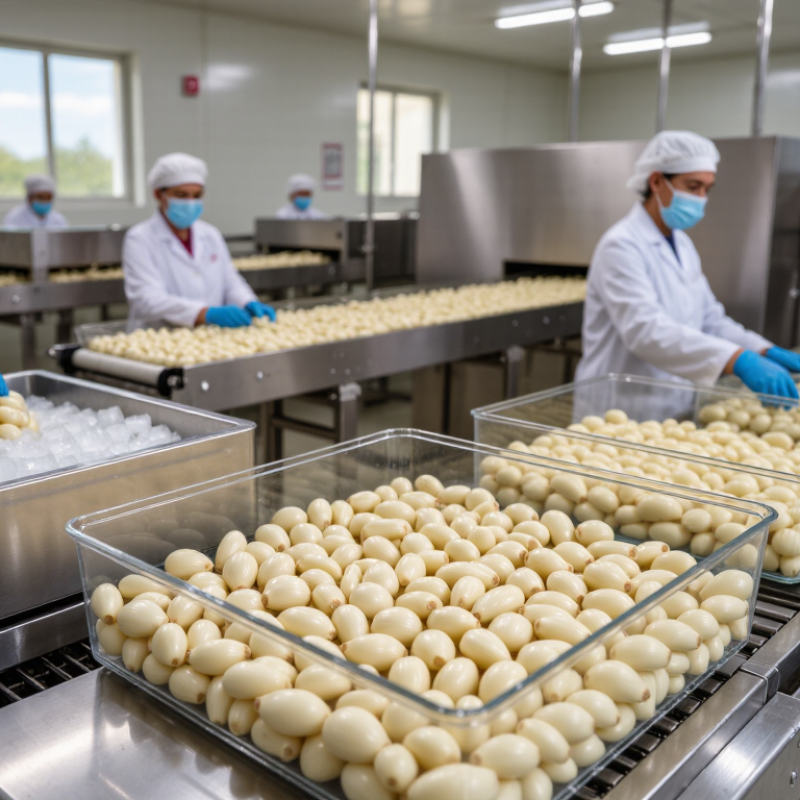
Fresh-peeled garlic sourcing starts with a measurable specification, not a supplier promise. Define clove size by diameter or count per kilogram. A practical trial range is 15–25 millimeters, with a stated tolerance for undersized cloves. USDA Agricultural Marketing Service grade standards emphasize size, firmness, cleanliness, and freedom from defects, although peeled garlic needs stricter internal controls.
Yield must be calculated from actual production trials. Use this formula: saleable peeled cloves divided by incoming garlic weight, multiplied by 100. Commercial trials often achieve about 65–75% usable yield, but cultivar, bulb maturity, and peeling damage can change the result.
Record skin loss, broken cloves, trimming, and rejected pieces separately. Do not trust one sample. Three lots are safer. I would not pretend that a high yield always means better value.
Keep peeled garlic between 0 and 4°C during storage and transport. The UC Davis Postharvest Technology Center recommends near 0°C storage for whole garlic, while peeled cloves require tighter hygiene and temperature monitoring. Measure product temperature, not only room temperature. Use clean, food-grade containers with drainage and visible lot codes.
A 2023 FAO food-loss report highlights how poor handling and temperature abuse reduce fresh-produce value before retail. That warning applies here. Garlic can look bright while its shelf life quietly declines. Set a receiving limit, such as no warm packs, leaking cloves, sour odor, or excessive condensation. Test shelf life under real distribution conditions. That part is often missed.

How to Source Fresh Peeled Garlic in 2026?
A reliable 2026 sourcing plan should begin with origin mapping, not supplier promises. FAOSTAT production data helps identify countries with substantial garlic output and long-term production stability. Compare harvested volume, yield trends, and cultivated area across recent years. A large crop does not always mean export-ready supply. Processing capacity, labor availability, and refrigeration can change the real picture.
USDA import records add a practical market view. They can show shipment origins, declared volumes, and seasonal arrival patterns into the United States. Match these records with FAOSTAT results to find origins that produce garlic and regularly move processed shipments. Classification can be imperfect, especially when peeled garlic appears under broader fresh or chilled categories. Data can mislead.
I would build a shortlist using three checks: production consistency, import frequency, and documented peeling capacity. Request harvest dates, peeling dates, storage temperatures, pack-house locations, and recent microbiological test results. A shipment arriving in January may use garlic harvested months earlier, so freshness needs evidence. Inspect sample cloves for dryness, yellowing, odor, and excess liquid. Confirm traceability from field to processing room, then compare records against customs documents and certificates. Keep that doubt. Official statistics may contain delays, revisions, or missing private transactions. A cautious buyer leaves room for those gaps instead of treating a spreadsheet as proof.
Mapping major garlic origins with FAOSTAT production data and USDA U.S. import records.
The blue bars show rounded 2022 garlic production in million metric tonnes reported by FAOSTAT. The orange bars show rounded 2024 U.S. import quantities of fresh or chilled garlic under HS 070320, based on USDA Foreign Agricultural Service import records, in thousand metric tonnes. China and India provide the deepest production base, while Argentina, Mexico, China, and Spain are important U.S. supply origins to evaluate for peeled-garlic sourcing. Product form, processing capability, food-safety certification, and shipment availability should be verified before contracting.
Sources: FAOSTAT Crops and Livestock Products and USDA FAS Global Agricultural Trade System. Production values are rounded for visualization; import values refer to fresh or chilled garlic and are not limited to peeled product.
How to Source Fresh Peeled Garlic in 2026?
Screen Suppliers Through FDA FSMA Controls and GFSI-Certified Audits
Fresh peeled garlic needs more than a low price and attractive samples. Screen each supplier against applicable FDA FSMA requirements. Request the facility’s hazard analysis, written food safety plan, sanitation records, environmental monitoring results, and recall procedures. Confirm whether the supplier handles, processes, or imports the product. Requirements can differ by activity and location.
For imported garlic, verify the responsible importer’s Foreign Supplier Verification Program records. Ask for recent corrective actions, not only clean documents.
A GFSI-recognized certification audit adds useful independent scrutiny. Check the certificate’s scope, site address, product category, issue date, and expiration date. The audit must cover peeled garlic handling, chilled storage, sanitation, and traceability where applicable. A polished certificate is not proof of daily discipline. Review audit findings and closure evidence. Test traceability with one recent lot, from receiving records to dispatch. Weak links often appear there.
Tips: Request a fresh product sample and inspect temperature, odor, seal quality, and visible moisture. Confirm the cold-chain target in writing. Ask how quickly the supplier can identify affected lots. Keep a written scorecard for every supplier. It may feel slow, but rushed approval creates larger problems. Recheck certificates before each contract renewal.
When sourcing fresh peeled garlic in 2026, treat temperature as a release requirement. The FDA Food Code 2022 sets 41°F (5°C) or below for cold holding time/temperature control for safety foods. Peeled garlic may not always receive that classification by itself. However, buyers should use 41°F as a preventive specification, especially for prepared or oil-packed products.
Peeled cloves have exposed surfaces, released moisture, and more handling than intact bulbs. Ask suppliers for lot-specific peeling, packing, dispatch, and transport records. At arrival, measure several bags from the warmest pallet area. Use a calibrated probe, sanitize it between samples, and record product temperature and receiving time. Do not trust one icy bag. Verify calibration with an ice-point check at 32°F (0°C). Hold or reject lots above 41°F unless a qualified review supports release.
The CDC’s widely cited 2011 burden report estimated 48 million foodborne illnesses, 128,000 hospitalizations, and 3,000 deaths annually in the United States. Those figures are not garlic-specific. They still show why small receiving failures matter. Sample validation should continue after receipt. Monitor opened packs under intended storage conditions. Check odor, purge, seal integrity, and temperature trends. Laboratory testing can support risk assessment, but it cannot replace cold holding. My imperfect assumption would be that a cold truck guarantees a cold product. It does not. FDA Food Code 2022 is a baseline; tighter buyer limits may be wiser.
How to Source Fresh Peeled Garlic in 2026
Fresh peeled garlic should arrive with a clearly confirmed shelf life of 7–14 days. Ask when the cloves were peeled, not only when they were packed. A printed date can hide important details. Request the production date, use-by date, storage temperature, and packaging conditions in writing. The cloves should look firm and moist, but never slimy. The aroma should be clean and sharp. Sour odors indicate possible deterioration.
Lot traceability must reach beyond a simple carton label. Each shipment should connect to a lot code, peeling date, processing facility, and delivery record. Keep a sample from every received lot when practical. Photograph the label and record the receiving temperature. This creates useful evidence if quality changes later. I once accepted a shipment after checking appearance alone. That was a mistake. The garlic softened sooner than expected, and the lot history was incomplete.
Refrigerated delivery needs active temperature control, not just a cold truck. Confirm the carrier’s temperature range, loading time, transit duration, and temperature log. Ideally, product temperature should remain within the agreed specification from dispatch to receiving. Inspect insulated packaging for condensation, broken seals, or warm surfaces. Reject unclear documentation before building a regular supply schedule. A reliable supplier should explain corrective actions when a shipment misses the 7–14-day expectation. Ask for a sample first. Then test it through several storage days under your actual kitchen conditions.
| Verification Dimension | Required Specification | Evidence to Request | Acceptance Criteria | Receiving Action |
|---|---|---|---|---|
| Product identity | Fresh, fully peeled garlic cloves intended for chilled distribution; no frozen or previously thawed product. | Product specification sheet and packing-list description. | Description, pack size, and condition match the purchase order. | Hold discrepancies for review before unloading. |
| Shelf-life at packing | A validated commercial shelf-life of 7–14 days from packing when continuously refrigerated and properly packaged. | Shelf-life validation report, packing date, and storage instructions. | Documented shelf-life falls within the 7–14-day purchasing requirement. | Reject or escalate products without documented validation. |
| Remaining shelf-life on receipt | At least 7 calendar days remaining, unless a shorter period is approved in writing before shipment. | Packing date, use-by date, and delivery date. | Date calculation confirms the agreed remaining-life threshold. | Apply reduced-life procedure or place the lot on hold. |
| Lot traceability | Every case and shipment must carry a unique lot code linked to the packing date and production records. | Lot code, packing record, shipment record, and traceability procedure. | One-step-back and one-step-forward records can be produced promptly. | Do not release unidentified or mixed lots. |
| Refrigerated storage | Maintain the product under chilled conditions, preferably at 0–4°C, according to the validated specification. | Storage temperature logs and calibration records for monitoring devices. | Records show continuous temperature control with no unexplained excursions. | Measure product temperature and document any deviation. |
| Refrigerated delivery | Use a clean, temperature-controlled vehicle or validated insulated shipping system. | Dispatch temperature, arrival temperature, transit duration, and temperature logger data when available. | Product arrives chilled, packaging is intact, and transit conditions meet the agreed range. | Inspect before acceptance; quarantine warm or damaged shipments. |
| Packaging and seal integrity | Food-contact packaging must be intact, clean, moisture-controlled, and suitable for chilled fresh-cut produce. | Packaging specification, seal inspection record, and packaging-material declaration. | No punctures, leaking liquid, broken seals, excessive condensation, or swollen packs. | Separate affected cases and record the defect by lot. |
| Appearance and odor | Cloves should be firm and clean, with normal garlic color and aroma; reject visible spoilage. | Receiving inspection checklist and representative sample results. | No mold, slime, severe discoloration, fermentation odor, or abnormal softening. | Record defects and determine acceptance using the agreed defect limit. |
| Food-safety documentation | Provide applicable sanitation, allergen, foreign-material, microbiological, and regulatory-control information. | Food-safety plan, recent verification results, and corrective-action records. | Documents are current, product-specific, and consistent with the supplied lot. | Place the lot on hold when required records are missing. |
| Receiving records | Capture lot code, quantity, packing date, use-by date, product temperature, vehicle condition, and inspector. | Completed receiving form with photographs for exceptions. | All critical fields are completed before inventory release. | Release only conforming lots; retain records according to the food-safety program. |
Sign up today to keep up with the newest information from one of the Southeast’s leading suppliers of fluid handling equipment!