
China Top 10 Plumbing Pipe Cutter Manufacturers

China’s plumbing tool industry has developed rapidly, and its Plumbing Pipe Cutter manufacturers now serve distributors, contractors, and maintenance teams worldwide. However, production scale alone does not prove dependable performance. A cutter may look strong in a catalog, yet struggle with thick stainless steel, uneven plastic pipe, or repeated job-site use.

This guide examines ten leading Chinese manufacturers through practical criteria. These include cutting capacity, blade quality, frame strength, adjustment accuracy, operator comfort, and quality-control systems. It also considers OEM experience, export reliability, certifications, spare-part access, and after-sales support. Richard Trethewey, a respected plumbing and heating expert, has often emphasized a simple principle: “The right tool makes the job safer and more predictable.” That principle matters when a clean cut affects joint alignment and leak prevention.

Real work is less polished than product photography. Mud, cramped cabinets, cold hands, and worn blades expose weaknesses quickly. Some manufacturers may excel at volume but offer limited customization. Others may produce excellent tools but lack consistent international support. This ranking therefore avoids treating every factory as equally capable. It reflects available company information, product evidence, industry experience, and practical purchasing concerns.

There is no perfect cutter.

Readers should verify current specifications directly with each supplier. Product lines, certifications, and production capabilities can change. The following overview is intended to make comparison clearer, not to replace sample testing or professional evaluation.
China Top 10 Plumbing Pipe Cutter Manufacturers

Understanding the Plumbing Pipe Cutter Industry in China

Understanding the Plumbing Pipe Cutter Industry in China

China’s plumbing pipe cutter industry combines metalworking, component supply, and tool assembly. Production often draws on established machining and heat-treatment capabilities. Factories make compact wheel cutters, ratcheting models, and larger tools for different pipe materials and diameters. A clean cut depends on more than blade sharpness. Wheel alignment, frame stiffness, and handle control also matter.

Small details matter.

For buyers comparing manufacturers, request samples that match the intended pipe material and size. Check whether cuts stay square and leave minimal burrs or deformation. Ask how blade hardness, replacement parts, and production consistency are verified. Clear inspection records offer stronger evidence than broad quality claims. Supplier capabilities vary, and a polished sample may not reflect every production batch.

That deserves attention.

Tips: Test several samples, not just one. Record the pipe type, diameter, and cutting result. Ask about spare wheels and routine maintenance. If specifications are unclear, resolve them before placing an order.

Types of Pipe Cutters Made by Chinese Manufacturers

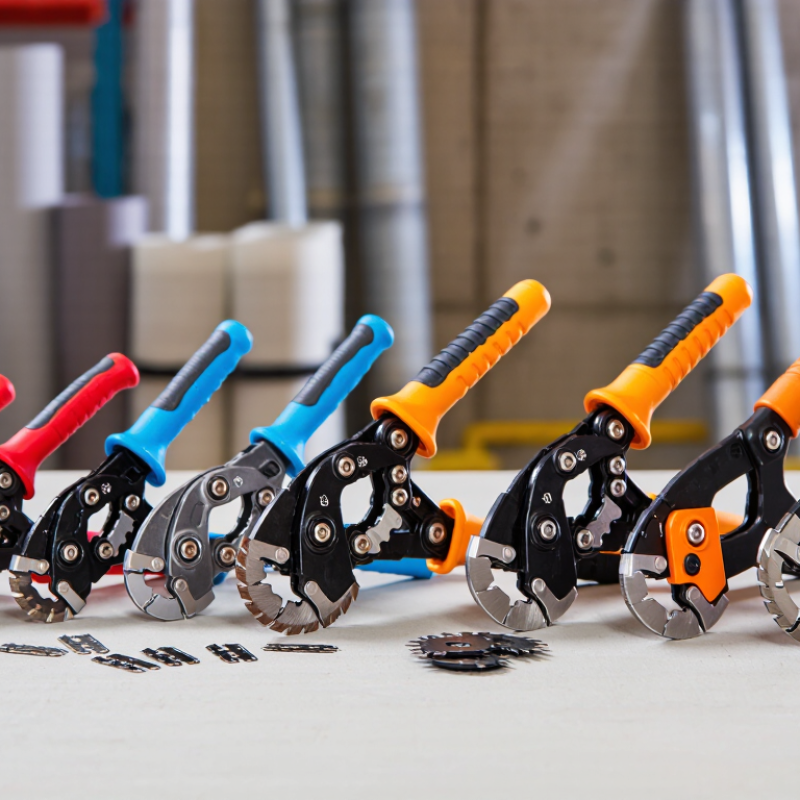
Chinese manufacturers make several pipe-cutter types for plumbing, construction, and maintenance work. Manual rotary cutters use a hardened wheel to score copper or thin-wall metal tubing. A small adjustment knob lets the user tighten the wheel gradually, helping limit tube deformation. Ratcheting cutters suit plastic pipe such as PVC and PPR; their short handles can be useful in crowded cabinets. For larger or tougher pipe, chain-style and powered cutters provide more leverage, though they need space and careful setup.

The U.S. EPA’s 2023 Drinking Water Infrastructure Needs Survey and Assessment estimates that the country needs $625 billion in drinking-water infrastructure investment over 20 years. This report does not measure cutter sales, but it highlights the scale of ongoing pipe renewal and repair. In practice, the right cutter depends on pipe material, outside diameter, wall thickness, and access. A clean cut still takes practice. Catalog descriptions can make selection look simpler than it is.

Tips: Check the cutter’s stated material and diameter range before ordering. Keep a spare cutting wheel for rotary models, and deburr the pipe end after cutting. A neat-looking cut is not always square; verify it before joining.

How to Evaluate China’s Leading Pipe Cutter Manufacturers

Evaluating China’s leading pipe cutter manufacturers requires more than comparing prices or catalogue photographs. Check whether each supplier tests cutters on the pipe materials you actually use, including copper, stainless steel, and plastic. Ask for cutting samples and inspect the edge for burrs, deformation, and blade drift. A clean first cut matters. Repeatability matters more.

The World Steel Association’s World Steel in Figures 2024 reports that China produced 1,019.1 million tonnes of crude steel in 2023, about 54% of global output. This scale supports a substantial materials supply chain, but it does not prove a cutter’s blade quality or service life. Ask manufacturers for blade hardness records, batch inspection results, and documented checks of cutting alignment. Also verify spare-blade availability, sample lead times, and how production changes are controlled. A factory audit can reveal whether inspection equipment is calibrated and whether rejected parts are recorded. Not enough to see a certificate. Match the test conditions to your own pipe sizes and wall thicknesses; I would not rely on one impressive sample alone. Small details are easy to miss.

China Top 10 Plumbing Pipe Cutter Manufacturers

How to Evaluate China’s Leading Pipe Cutter Manufacturers

This weighted evaluation model helps buyers compare plumbing pipe cutter manufacturers without relying only on price. Product quality and cutting performance receive the highest weights, while durability, compliance, customization, delivery capability, and after-sales support complete the assessment. The weights total 100% and can be adjusted according to project requirements.

Profiles of Ten Notable Chinese Plumbing Pipe Cutter Manufacturers

China’s plumbing pipe cutter sector includes ten notable manufacturers with different strengths. Some focus on compact ratchet cutters for PEX and PVC pipes. Others produce heavy-duty tools for thicker plastic tubing and multilayer systems. Several workshops use forged aluminum bodies, hardened steel blades, and replaceable cutting wheels. Their production lines often combine CNC machining, manual assembly, and functional inspection.

The profiles show practical differences. Some manufacturers prioritize high-volume export orders and consistent packaging. Others offer private-label development, color customization, and small trial batches. Experienced buyers should examine blade alignment, handle comfort, cutting capacity, and spare-part availability. A clean cut matters. It reduces burrs and installation delays. However, catalog claims are not enough. Request sample tools, inspection records, material details, and recent quality data before making a decision. Even reliable factories may show uneven performance between product models.

Tips: Test the cutter on the actual pipe material and wall thickness. Check whether replacement blades are easy to obtain. Ask how the factory controls hardness, edge sharpness, and final assembly. Confirm packaging protection for long-distance shipping. A simple trial can reveal loose pivots, rough edges, or excessive handle movement. Product photos cannot show these faults. Supplier communication also deserves attention, although it is often overlooked. Be willing to reconsider an attractive price if after-sales support remains vague.

Manufacturing Standards, Quality Control, and Export Markets

China’s top 10 plumbing pipe cutter manufacturers compete through controlled production, material selection, and export reliability. Strong factories usually operate under documented quality systems, often aligned with ISO 9001 principles. They inspect steel hardness, wheel alignment, handle strength, and cutting performance before shipment. Small details matter. A poorly aligned wheel can leave uneven edges on copper or stainless-steel pipe.

Experienced manufacturers use incoming material records and batch tracking. This allows inspectors to connect a finished cutter with its steel source, heat treatment, and assembly line. Production checks may include repeated cutting tests, thread inspection, surface coating checks, and packaging drop tests. However, no factory is flawless. Some inspections still depend heavily on manual judgment, which can create inconsistent results between shifts. Independent sampling can reveal problems hidden by routine internal checks.

Export markets demand more than a competitive price. Buyers in Europe, North America, Southeast Asia, and the Middle East may require different packaging, labeling, technical files, or conformity documents. Reliable suppliers confirm destination requirements before production begins. They also protect cutting wheels from moisture during ocean transport. A clean carton is not enough. Export teams must manage customs descriptions, spare parts, inspection reports, and replacement policies. Delivery records and customer feedback offer useful evidence, but they should be reviewed carefully. Low complaint numbers may reflect limited follow-up rather than perfect quality.

China Top 10 Plumbing Pipe Cutter Manufacturers - Manufacturing Standards, Quality Control, and Export Markets

Industry overview of common manufacturing and export considerations; this is not a company ranking or a set of company-specific claims.

No. Manufacturing Area Relevant Standard or Requirement Typical Quality-Control Evidence Export-Market Relevance
1 Quality management ISO 9001:2015 provides requirements for a quality management system; certification is voluntary unless required by a buyer or contract. Documented inspection procedures, nonconformance records, corrective actions, and supplier controls. Useful for supplier qualification across North America, Europe, and other international markets; it is not product certification.
2 Environmental management ISO 14001:2015 specifies requirements for an environmental management system. Environmental objectives, waste-handling procedures, and records for relevant operational controls. Can support buyer and supply-chain environmental assessments; certification does not establish product performance.
3 Worker health and safety ISO 45001:2018 specifies requirements for an occupational health and safety management system. Risk assessments, machine-guarding checks, training records, and incident-monitoring procedures. Relevant to responsible-sourcing reviews and factory audits conducted by overseas buyers.
4 Blade and component materials Material grade and heat-treatment requirements should be defined in the product specification or technical drawing; there is no single universal pipe-cutter material specification. Incoming-material identification, supplier certificates where applicable, and documented hardness or dimensional checks against specified criteria. Supports consistent supply to distributors serving plumbing and construction markets worldwide.
5 Cutting capacity and performance Capacity should be stated for the intended pipe materials and size range; performance limits are product-specific and should be verified against the manufacturer’s declared specification. Sample cuts on specified pipe types and sizes, with results checked against defined acceptance criteria for cut quality and operation. Clear capacity information helps buyers match tools to local plumbing materials and product requirements.
6 Dimensional consistency Product drawings should specify critical dimensions and tolerances. Tolerances should be agreed for each design rather than assumed to be universal. Calibrated measuring tools, first-piece checks, and recorded inspection of critical features such as blade alignment and pipe-size adjustment. Helps maintain consistent fit, operation, and replacement-part compatibility across export orders.
7 Corrosion-resistance evaluation ASTM B117 describes operation of a salt-spray (fog) apparatus; it does not set a universal pass/fail threshold for pipe cutters. Where required by the buyer, use an agreed test duration, sample preparation, and acceptance criteria, then retain the test report. May be requested for tools sold into humid, coastal, or professional-use environments; requirements vary by buyer and product.
8 Product chemical compliance EU REACH requirements may apply to articles, including obligations concerning substances of very high concern. EU RoHS applies to in-scope electrical and electronic equipment, not typically to a purely manual mechanical cutter. Material declarations and supplier documentation appropriate to the product and destination-market obligations. EU-related obligations depend on product composition, intended use, and applicable legislation; confirm scope for each SKU.
9 Consumer-product safety information The EU General Product Safety Regulation (EU) 2023/988 has applied since 13 December 2024 to consumer products within its scope, subject to applicable exclusions and sector-specific rules. Product identification, traceability information, risk documentation, and required warnings or instructions for the intended market. EU obligations depend on whether the product is intended for consumers and how it is placed on the market; check current destination-country rules.
10 Export packaging and traceability ISPM 15 applies to regulated wood packaging material used in international trade; it does not apply to the tool itself. Non-wood packaging is outside its scope. Packaging checks for product protection, quantity, labels, and batch identification; verify wood-packaging treatment and marking where required. Relevant to shipments to international destinations, including North America, Europe, and Asia-Pacific; import and marking rules vary by destination.

Note: Standards and regulatory obligations depend on product design, intended use, sales channel, and destination market. Confirm current requirements with the relevant authorities or a qualified compliance professional.

Stay Connected

Sign up today to keep up with the newest information from one of the Southeast’s leading suppliers of fluid handling equipment!