
China has become a major sourcing destination for Ceramic Cooking Ware, serving retailers, restaurants, and kitchen brands worldwide. Its manufacturers produce ceramic pots, casserole dishes, baking trays, and glazed cookware in many sizes and styles. However, choosing a reliable supplier requires more than comparing catalog prices.
A strong manufacturer should demonstrate practical control over clay preparation, molding, glazing, firing, and final inspection. Buyers should ask about material composition, food-contact safety, thermal-shock testing, and production consistency. Factory visits, sample reviews, and independent laboratory reports can provide valuable evidence. Details matter. A smooth rim, even glaze, and stable base often reveal better process control.
Not every attractive sample reflects mass-production quality. That is easy to overlook. Some suppliers communicate well but struggle with color matching or delivery planning. Others offer excellent craftsmanship yet lack flexible packaging options. This guide examines China’s leading Ceramic Cooking Ware manufacturers through product capability, manufacturing experience, quality systems, customization support, and export reliability. It also considers how companies respond when defects appear, because accountability is more meaningful than polished sales language.
Manufacturing strengths can vary by region and factory size. Large producers may offer stronger capacity, while specialized workshops may provide more distinctive designs. Buyers should verify claims against current documentation and production samples. The right partner is not always the cheapest one. It is the supplier that can consistently deliver safe, durable, well-finished cookware for the intended market.
Ceramic cookware manufacturing in China is a mature, process-driven industry. Factories commonly manage clay preparation, slip casting, pressing, glazing, kiln firing, and final inspection under one production system.
UN Comtrade’s 2023 HS 6912 data places China among the leading exporters of ceramic kitchen and household articles. However, this category includes more than cookware, so buyers should avoid treating export totals as pure cookware figures.
Market demand is also expanding. Grand View Research’s 2024 assessment estimates the global ceramic cookware market at roughly US$2.5 billion in 2023, with growth continuing at about 6% annually through 2030.
Chinese manufacturers benefit from dense supplier networks, skilled kiln operators, and flexible order volumes. Product quality still varies. A glossy surface does not prove strong thermal-shock resistance.
Testing should include coating adhesion, heat cycling, dimensional stability, and food-contact safety. Some factories look impressive during visits but provide weak batch records. That deserves attention.

China Top Ceramic Cooking Ware Manufacturers?
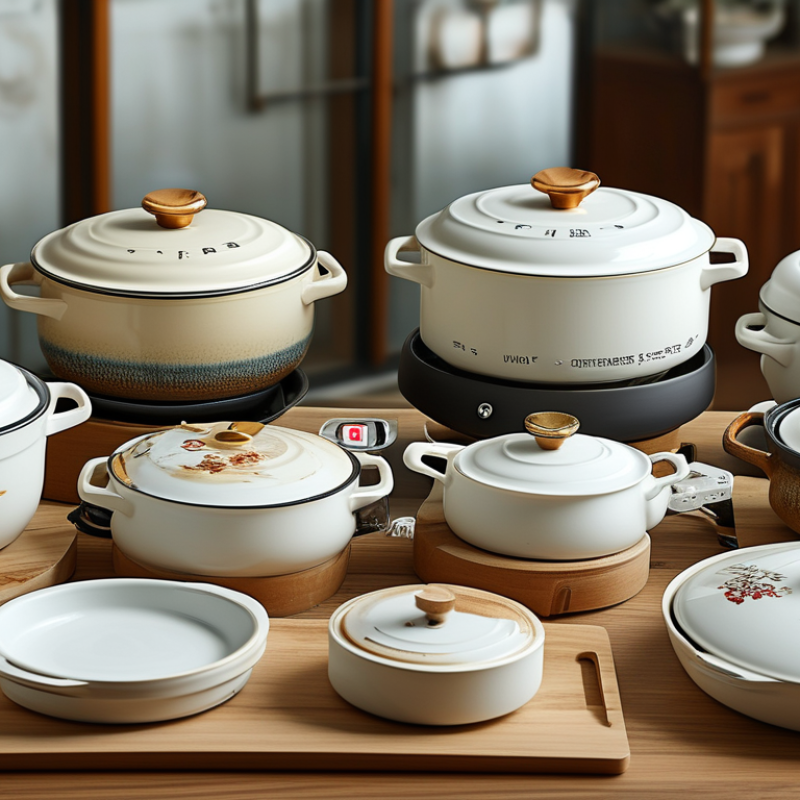
Chinese ceramic cookware manufacturers produce more than basic casserole dishes. Their key product range includes glazed ceramic pots, stoneware baking dishes, ceramic frying pans, soup pots, and lidded braisers. Some factories also make ceramic-coated metal cookware for lighter handling and faster heating. Each type serves a different kitchen task. A deep casserole suits slow stews, while a shallow baking dish works well for gratins and roasted vegetables.
Experienced manufacturers usually control clay selection, molding, glazing, firing temperature, and final inspection. These steps affect heat distribution, surface strength, lid fit, and resistance to thermal shock. Reliable suppliers should provide food-contact test reports and clear care instructions. Buyers should also check whether the cookware suits gas, electric, or induction stovetops. Not every ceramic product supports every heat source. That detail is often missed.
Tips: Ask for sample pieces before placing a large order. Inspect the glaze under bright light. Small pinholes, uneven edges, or loose handles deserve attention. Request packing tests, especially for heavy pots with glass lids. I have found that attractive samples can hide weak carton protection. The product may look excellent, yet arrive chipped after shipping. Careful testing remains more useful than polished catalog photos.
| Product Type | Typical Construction | Common Sizes | Suitable Heat Sources | Typical Applications | Key Manufacturing Considerations |
|---|---|---|---|---|---|
| Ceramic-Coated Frying Pan | Aluminum body with a sol-gel ceramic non-stick coating | 20–30 cm diameter | Gas, electric, and ceramic-glass cooktops; induction requires a magnetic base | Eggs, pancakes, sautéing, and shallow frying | Coating adhesion, even thickness, flatness, and resistance to thermal cycling |
| Ceramic-Coated Saucepan | Cast or stamped aluminum body with a ceramic non-stick interior | 1.5–3.0 L capacity | Gas, electric, ceramic-glass, and induction when fitted with a magnetic base | Sauces, grains, vegetables, and reheating | Lid fit, rivet or handle attachment, coating durability, and controlled wall thickness |
| Ceramic-Coated Wok | Deep aluminum or multi-layer metal body with a ceramic coating | 28–36 cm diameter | Gas, electric, and ceramic-glass; induction depends on the base design | Stir-frying, steaming with a rack, braising, and one-pan meals | Uniform heat distribution, stable base geometry, coating protection, and handle strength |
| Solid Ceramic Casserole | Vitrified ceramic or stoneware body, usually with a glazed interior | 1–4 L capacity | Oven and microwave when specifically rated; direct stovetop use only when stated by the manufacturer | Slow cooking, braising, soups, and table serving | Thermal-shock resistance, glaze consistency, controlled firing, and food-contact safety |
| Ceramic Baking Dish | Oven-safe stoneware or porcelain with a glazed surface | Small individual dishes to 33 × 23 cm family-size formats | Oven and microwave when rated; not generally suitable for direct flame | Casseroles, lasagna, roasting, gratins, and desserts | Dimensional accuracy, edge strength, smooth glazing, and resistance to sudden temperature changes |
| Ceramic Grill Pan | Cast aluminum or steel body with raised ribs and a ceramic non-stick coating | 24–30 cm diameter or rectangular formats | Gas, electric, and ceramic-glass; induction depends on the base | Grilling meat, seafood, vegetables, and sandwiches | Rib definition, coating coverage on raised surfaces, warp resistance, and easy-clean performance |
| Ceramic Tagine | Glazed earthenware or stoneware base with a conical ceramic lid | 1–3.5 L capacity | Oven use when rated; stovetop use requires compatible construction or a heat diffuser | Low-temperature braising, stews, poultry, and vegetables | Lid-to-base fit, moisture circulation, thermal-shock control, and glaze uniformity |
| Ceramic Ramekin | Glazed porcelain or stoneware in a small, thick-walled format | 90–250 ml capacity | Oven and microwave when rated | Soufflés, crème brûlée, baked eggs, sauces, and portioned desserts | Uniform wall thickness, chip resistance, glaze quality, and repeatable capacity |
Note: Heat-source compatibility, maximum oven temperature, and dishwasher suitability vary by construction and product specification. Ceramic-coated cookware and solid ceramic cookware are different product categories and should be evaluated separately.
China’s leading ceramic cooking ware manufacturers usually work with stoneware, porcelain, or high-alumina clay. Each material changes heat retention, weight, durability, and surface appearance. Stoneware feels solid and holds steady heat. Porcelain offers a smoother body but may need tighter firing control. High-alumina formulations can improve thermal resistance, although they often cost more. Experienced manufacturers test clay moisture, glaze fit, and kiln temperature before large-scale production.
Production commonly includes material milling, forming, drying, glazing, firing, and inspection. Pressing suits consistent shapes, while slip casting supports detailed designs. Skilled technicians check for pinholes, warping, uneven glaze, and hairline cracks. They also test thermal shock by moving ware between controlled hot and cool conditions. Food-contact testing should examine heavy metals, glaze stability, and surface migration under acidic foods. A clean factory matters. So does accurate documentation. No production line is flawless, and quality teams should record defects instead of hiding them. That honesty can reveal weak drying or uneven kiln zones.
Tips: Ask for material specifications, firing temperatures, and recent test reports. Request samples from different production batches. Check the base, rim, handles, and glaze under bright light. A beautiful sample proves little if batch control is weak. Also, confirm dishwasher, oven, and microwave suitability through written testing, not casual claims. Manufacturers should explain their quality standards clearly, even when an improvement is still needed.
How to Evaluate China’s Top Ceramic Cookware Manufacturers
Choosing a ceramic cookware manufacturer requires more than comparing catalog photos. Visit the factory, if possible, or request a live video tour. Examine forming, glazing, firing, inspection, and packing areas. Clean floors and organized records do not prove everything, but they reveal working habits.
Ask for recent food-contact test reports from accredited laboratories. Check lead, cadmium, thermal shock, coating durability, and dimensional consistency. Request samples from different production batches. One attractive sample can hide unstable quality. Test the cookware on gas, electric, and induction surfaces when relevant. Measure handle heat, lid fit, surface scratches, and resistance to repeated washing. Product safety depends on both materials and manufacturing control.
Tips: Verify certificates with the issuing laboratory. Ask who owns the molds. Confirm minimum order quantities, replacement terms, packaging strength, and inspection procedures. Require written specifications before production begins. Keep photos of approved samples. A small pilot order is often wiser than a large first shipment. Many buyers focus on glaze color and forget carton drop testing. That mistake can become expensive. No audit is perfect. Recheck critical details before every shipment.
Use a weighted supplier scorecard to compare manufacturers consistently. The suggested weighting emphasizes product safety, quality consistency, production capability, and export readiness rather than brand visibility.
Recommended evaluation weights: verify food-contact compliance, coating or glaze performance, factory quality systems, production capacity, delivery reliability, customization capability, and total cost before selecting a supplier.
China’s ceramic cooking ware manufacturers serve buyers across Europe, North America, Southeast Asia, and the Middle East. Each market can require different food-contact documents, packaging tests, and labeling details. Export experience matters because a product may pass factory inspection but fail a destination-market requirement. Ask for recent test reports, production photos, and shipment references. Real evidence is more useful than polished claims.
Customization often covers shape, glaze color, handles, capacity, logo placement, and retail packaging. A deep casserole may need thicker walls for heat retention, while a small baking dish needs stable dimensions for shelf packing. Request a pre-production sample. Check its weight, surface finish, lid fit, and resistance to thermal shock. Small color differences can appear between sample and mass production. This risk deserves written control.
Supplier selection should include factory audits, quality checkpoints, mold ownership, minimum order quantities, and replacement terms. Compare total cost, not only the quoted unit price. Packaging strength matters after a long sea journey. I would also ask how the supplier manages cracked pieces and delayed materials. A lower price can hide higher waste. No supplier is perfect. A clear corrective-action process may matter more than an impressive showroom. Require approval before bulk production begins.
Sign up today to keep up with the newest information from one of the Southeast’s leading suppliers of fluid handling equipment!